How Many Open Loops Are in Your Head Right Now?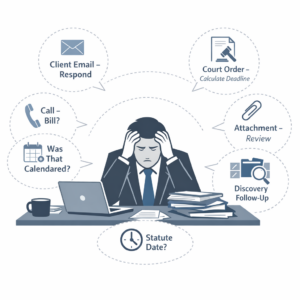
Did I respond to that client?
Did I calendar that deadline from the court order?
Did I assign that task?
Did I bill that call?
Did we follow up?
Most firms operate with dozens of unresolved operational loops. The profession treats this as normal. It shouldn’t. Clio’s Manage AI goes a long way to reduce the buzz of uncertainty.
Challenging Four Assumptions
1. “We Already Track Our Time.”
Most attorneys believe they do. But small increments vanish daily — short calls, quick email exchanges, document edits reconstructed imperfectly at day’s end.
AI-assisted time suggestions analyze matter activity — emails, documents, calendar events — and generate draft time entries. Lawyers review and approve rather than reconstruct.
That shift alone reduces revenue leakage without increasing workload.
2. “We Don’t Miss Deadlines.”
Most firms do not miss filing dates. That is not the real risk.
The risk lies in what never becomes structured:
• A court order reviewed but not task-assigned
• A follow-up implied but not entered
• A deadline calculated but not linked to responsibility
AI helps convert incoming communications into:
Deadline → Task → Assigned Person → Tracked Completion
This reduces reliance on email forwarding chains and manual extraction. Administrative staff spend less time transcribing court language. Lawyers spend less time double-checking that tasks were properly created.
Oversight remains. Mechanical friction decreases.
3. “We Stay in Touch with Our Clients.”
This assumption is more fragile than firms admit.
Client communication gaps rarely occur because lawyers are indifferent. They occur because:
• Activity is fragmented across email, calendar, and documents
• Follow-ups are implied but not formalized
• No structured prompt exists to re-engage
Clio’s AI-assisted tools can help draft communications based on recent matter activity.
For example:
• After a filing, the system surfaces activity and suggests a client update draft.
• After a period of inactivity, it can highlight matters without recent communication.
• Based on logged calls or document uploads, it can assist in drafting status summaries.
This does not replace judgment. It reduces initiation friction.
Instead of staring at a blank email window, lawyers begin with structured context: recent activity, key dates, and a draft outline. That lowers the barrier to proactive communication.
Consistent client updates become a workflow function, not a memory function.
4. “Clio Is Just Billing Software.”
Used passively, it is a repository with invoices attached.
Used intentionally with AI features enabled, it becomes an operational dashboard:
• Emails auto-associated to matters
• Time suggested from activity
• Tasks generated from communication
• Deadlines centralized
• Client updates prompted and draft-assisted
• Search powered by natural language
The system shifts from storage to control infrastructure.
The Real Benefit
Yes, Clio Manage AI saves time.
But more importantly, it reallocates effort:
• Administrative staff move from rote calendaring to coordination.
• Lawyers move from reconstruction and reminder-chasing to substantive legal work.
• Client communication becomes structured rather than episodic.
• Open loops shrink.
In a profession defined by volume and liability, reducing mechanical workflow and communication gaps is not cosmetic improvement.
It is operational stability.
And it closes loops before they turn into risk or client dissatisfaction.
Now is the time
If your firm wants to grow, improve client experience, and end the uncertainty of open loops, using Clio Manage with Manage AI can give you peace of mind and increase your ability to take on new matters. Our team at Crosspointe Consulting Group is dedicated to finding solutions for law firms to help them work smarter and more efficiently. We offer needs analysis, consultation, implementation, training and support. It may involve new programs or helping our clients get the most from what they already have. You are welcome to call us at (877) 375-2810 or write to us at info@crosspointecg.com.

With clients throughout North America, Andrea Prigot guides firms through the selection, migration and implementation of billing, accounting, document management and practice management software. An experienced implementer and trainer, her current certifications include Caret Legal, Clio, NetDocuments, Cosmolex and TimeSolv. She also holds certifications in Amicus Attorney, Time Matters, Timeslips, PCLaw and Worldox.
Andrea is a founding member of Crosspointe Consulting Group, and president of Amicus Consulting, Inc., and has been a speaker and panelist on CLE programs for the New York State Bar Association and the Westchester County Bar Association.